
The effectiveness of the therapist and his practice depends, among other factors, on his training. Studying and reading the main books on the approach is very important and provides the basis for the therapist to fill his “toolbox”. However, you need to know how to use these tools, and this is only possible when practice is combined with theory. With this need in mind, the Cefi Contextus nucleus created a course that aims to teach and experience the practice of the main concepts of Acceptance and Commitment Therapy.
There will be 5 meetings that aim to put the contextual behavioral processes of acceptance and change into practice through role-plays and exercises in small groups. The student will be able to practice the main concepts of ACT, learning from case formulation, functional analysis, intervention tools (such as the Matrix), to the importance of the therapeutic relationship.
General Objective:
The professional or student who completes the course will be able to formulate and intervene based on Acceptance and Commitment Therapy, using some tools to enhance the therapeutic process.
Specific objectives:
Explain the psychological flexibility model and its clinical relevance;
Describe the 6 central processes of ACT (acceptance, defusion, contact with the present moment, self as contexts, values and committed action) in a functional way;
Introduction to Functional Contextualism;
Know and understand the Matrix as a clinical intervention tool based on the 6-step protocol;
Develop a functional case formulation in ACT identifying patterns of experiential avoidance and cognitive fusion;
Map deficits in the 6 psychological flexibility processes and organize this information into a model that guides clinical hypotheses;
Use the Therapeutic Relationship as a tool for formulating cases and managing clinical processes.
Exercise the creation and adaptation of ACT interventions, based on processes using language, metaphors and experiential strategies;
Classes will be taught online, synchronously, with lectures and practical materials for formulating clinical cases and self-practice of the processes taught.
Cefi is a pioneer in teaching Contextual Behavioral Therapies in Rio Grande do Sul, with a specialization course since 2014;
The Contextus Center is made up of specialized professionals who are in constant training, meeting weekly for training, study and research in the area;
The course was designed to address the need for therapists to exercise clinical skills in a safe and learning environment;
The course is innovative with a focus on clinical practice;
Introduces several practical and experiential tools;
In addition to the theoretical basis, this course focuses on the practice and experience of clinical skills;
Highly qualified teachers in the approach that teach HOW to do it.
Technical Coordination:
Martha Wallig Brusius Ludwig
Administrative coordination:
Mara Lins
Enroll in the course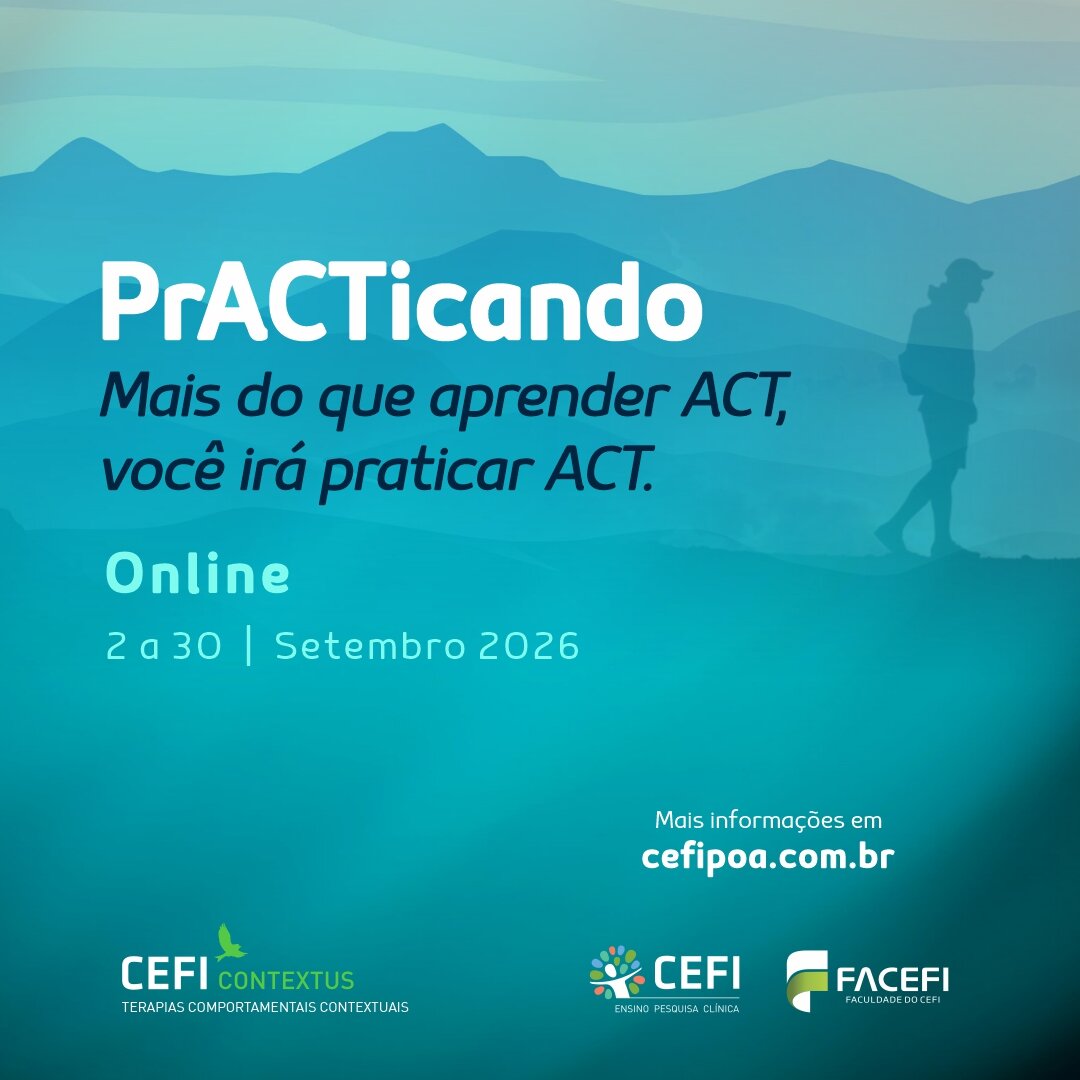

Psychologists, psychiatrists, psychology and psychiatry students

8pm

September 2nd to September 30th.